Uncovering the kinase switch to coordinate symbiosis and immunity
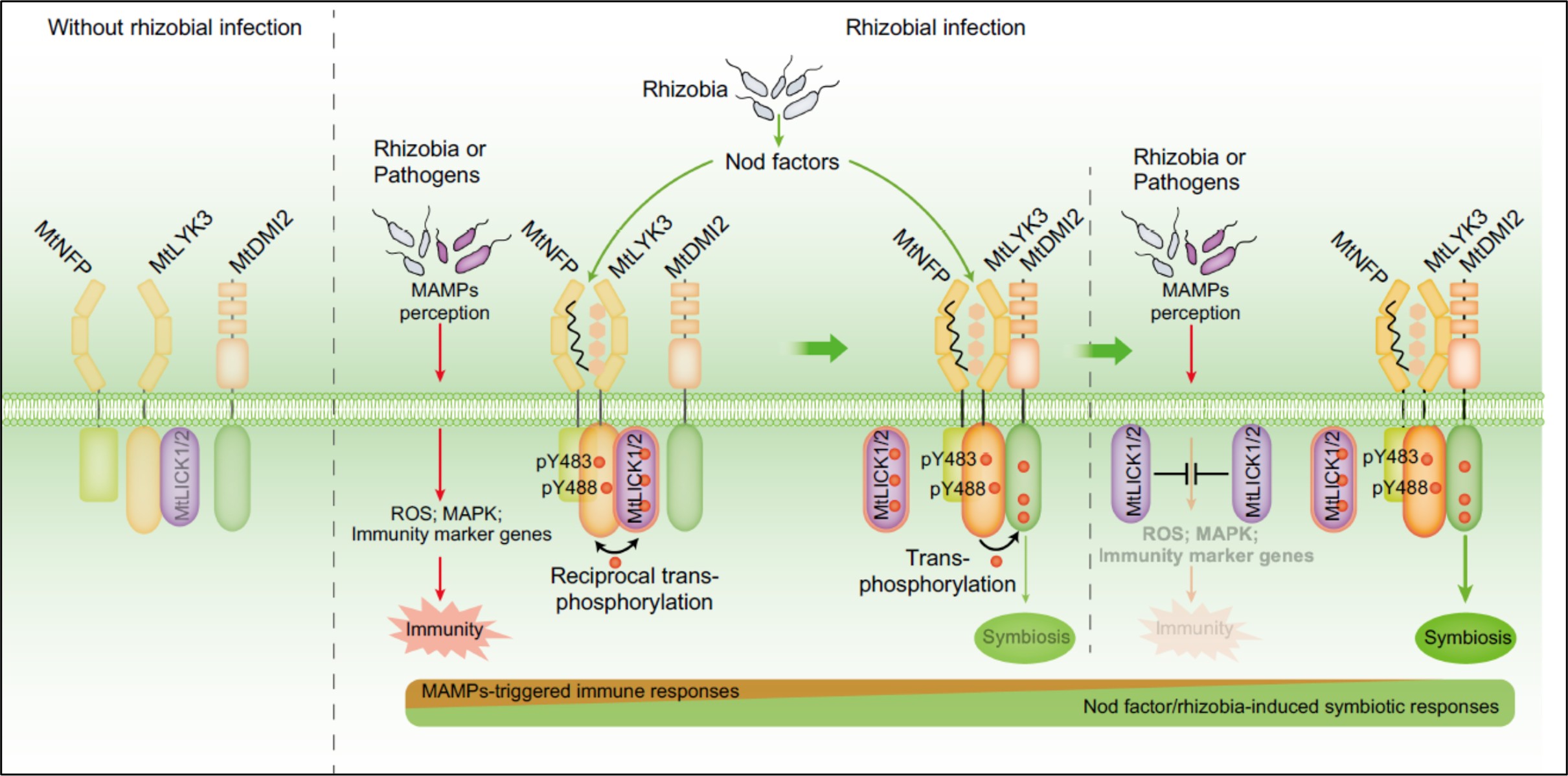 Biological nitrogen fixation is a vital natural process that converts atmospheric nitrogen into bioavailable forms, enabling its assimilation into essential biomolecules such as amino acids and nucleic acids. This unique capability is primarily carried out by specialized microbes, often through their symbiotic association with legume plants. The success of this symbiosis depends on the plants’ ability to accurately recognize and selectively interact with beneficial microbial partners while actively excluding potential pathogens. In Medicago truncatula, recognition of nitrogen-fixing rhizobia occurs through the interaction between the bacterial Nod factor signals and the plant receptor kinases MtLYK3and MtNFP. Although this selective recognition is a well-established concept, the molecular mechanisms mediating the switch between symbiotic and immune signaling remain elusive. In a recent study, Wang and colleagues used yeast two-hybrid cDNA library screening to identified MtLICK1 and MtLICK2 as MtLYK3 interactors. Functional studies revealed that mutations in MtLICK1/2 impair the expression of symbiotic marker genes and reduce nodule formation. Using further genetic and biochemical assays, the authors demonstrated that MtLICKs and MtLYK3 form a reciprocal trans-phosphorylation module. This module activates symbiotic signaling while simultaneously repressing immune responses. These findings position MtLICK1/2 as critical kinases that activate MtLYK3, thus resolving a long-standing question in legume symbiosis research. (Summary by Ching Chan @ntnuchanlab) Nature 10.1038/s41586-025-09057-0