

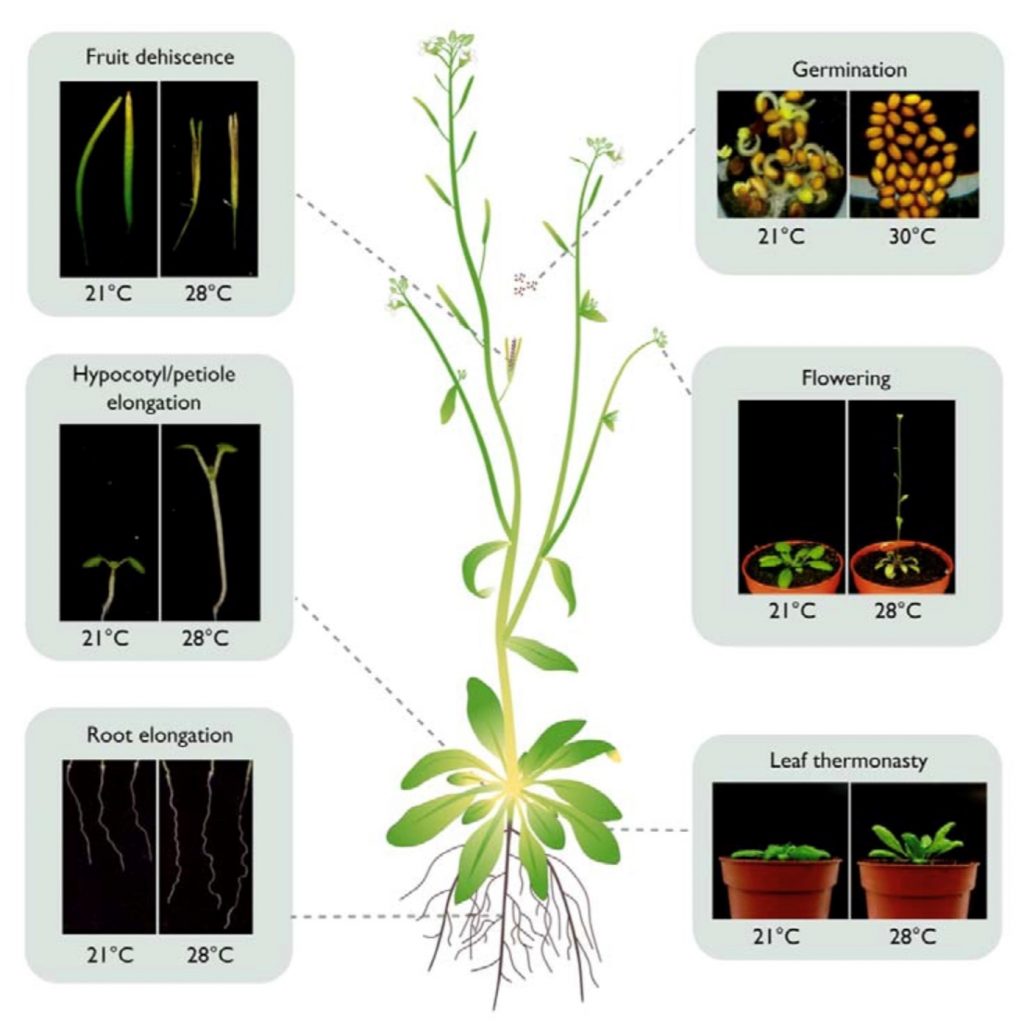
Review: Developmental thermal responses in Arabidopsis (Plant Physiol.)
Plant Science Research WeeklyPlants can modify their growth in response to environmental challenges. In a recent review, Vu et al. summarize the molecular mechanisms underlying high temperature responses during the Arabidopsis life cycle. At early stages, high temperature promotes abscisic acid (ABA) biosynthesis and decreases gibberellic…

Review: Developmental responses to water and salinity in root systems ($) (Annu Rev Cell Biol)
Plant Science Research WeeklyPlants lack organs that are analogous to human ears, eyes or fingertips, yet they can detect changes in their environment. In this review, Dinneny describes how sensing heterogeneities in salt and water leads to changes in root architecture, optimizing soil foraging. The root tip typically follows the…

Evolution of fast root gravitropism in seed plants (Nature Comms)
Plant Science Research WeeklyPlants’ invasion of land was accompanied by the evolution of a root system which in seed plants includes a fast gravitropic response. Gravitropism occurs through three distinct steps – (1) gravity perception by dense starch-filled amyloplasts, (2) transmission of gravitropic signal by auxin through…

Cytoskeleton dynamics necessary for early events of lateral root initiation (Curr. Biol.)
Plant Science Research WeeklySymmetric cell division leads to proliferation, and asymmetric cell division establishes differential growth. Formation of lateral roots (LRs) depends on asymmetric division of initially symmetric founder cells. Barro et al. studied the mechanism of asymmetric radial expansion by analyzing cytoskeleton…

A KNOX-cytokinin regulatory module predates the origin of indeterminacy (Curr. Biol.)
Plant Science Research WeeklyIn vascular plants, new organs (e.g., leaves) are produced continuously from the shoot meristem, a process coined indeterminacy. The sister lineage of vascular plants, bryophytes, develop differently, ending with the formation of a determinate spore-bearing shoot (sporangium). The genetic underpinning…

Physcomitrella STEMIN transcription factor induces stem cell formation with epigenetic reprogramming (Nature Plants)
Plant Science Research WeeklyInsights into transcription factors (TFs) in non-flowering plants are increading thanks to the establishment of new bryophyte model organisms. In new work, Ishikawa et al. present STEMIN1, a Physcomitrella patens TF belonging to an uncharacterized subgroup of the AP2/ERF family. Physcomitrella undergo…
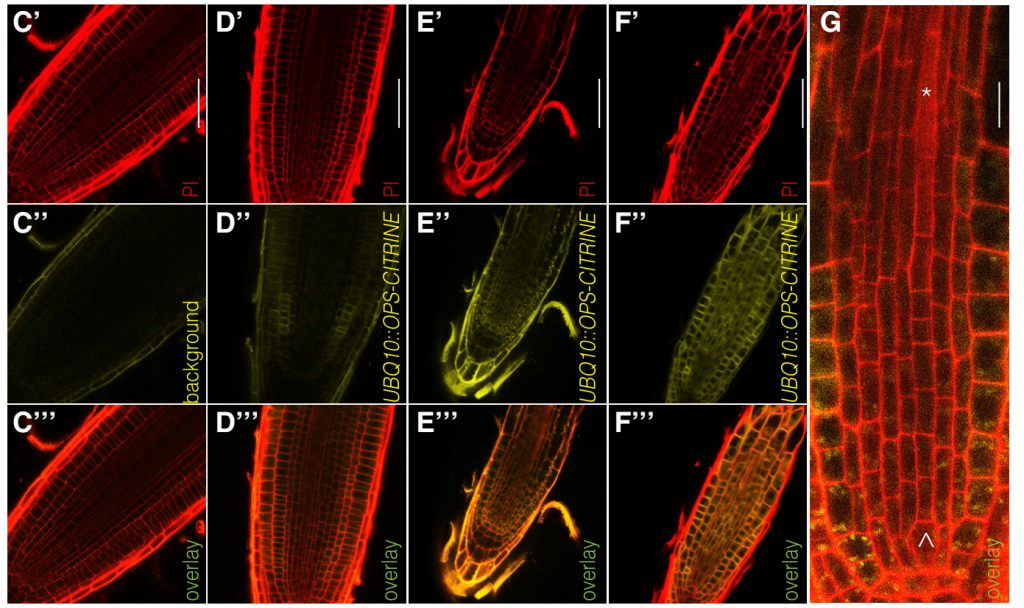
An insulator of CLE-signaling boosts cell-differentiation in protophloem formation
Plant Science Research WeeklyWaddington’s epigenetic landscape, a famous metaphor in developmental biology, depicts how a stem cell progresses from an undifferentiated state to a differentiated one. To some degree this metaphor can also be applied to root cell differentiation. It’s well-known that the CLE-45 peptide and its…
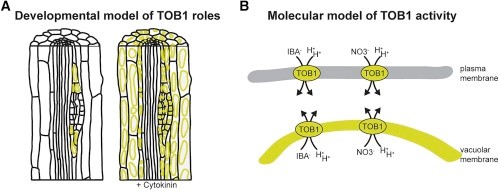
TRANSPORTER OF IBA1 links auxin and cytokinin to influence root architecture ($) (Devel. Cell)
Plant Science Research WeeklyIndole-3-butyric acid (IBA) is the precursor of the hormone auxin and it controls the formation of lateral roots. Evidence suggests that IBA is converted to IAA, endogenous active auxin. The major study material to distinguish between IBA and IAA was highlighted by the IBA-specific efflux carrier ABCG36/PDR8/PEN3,…
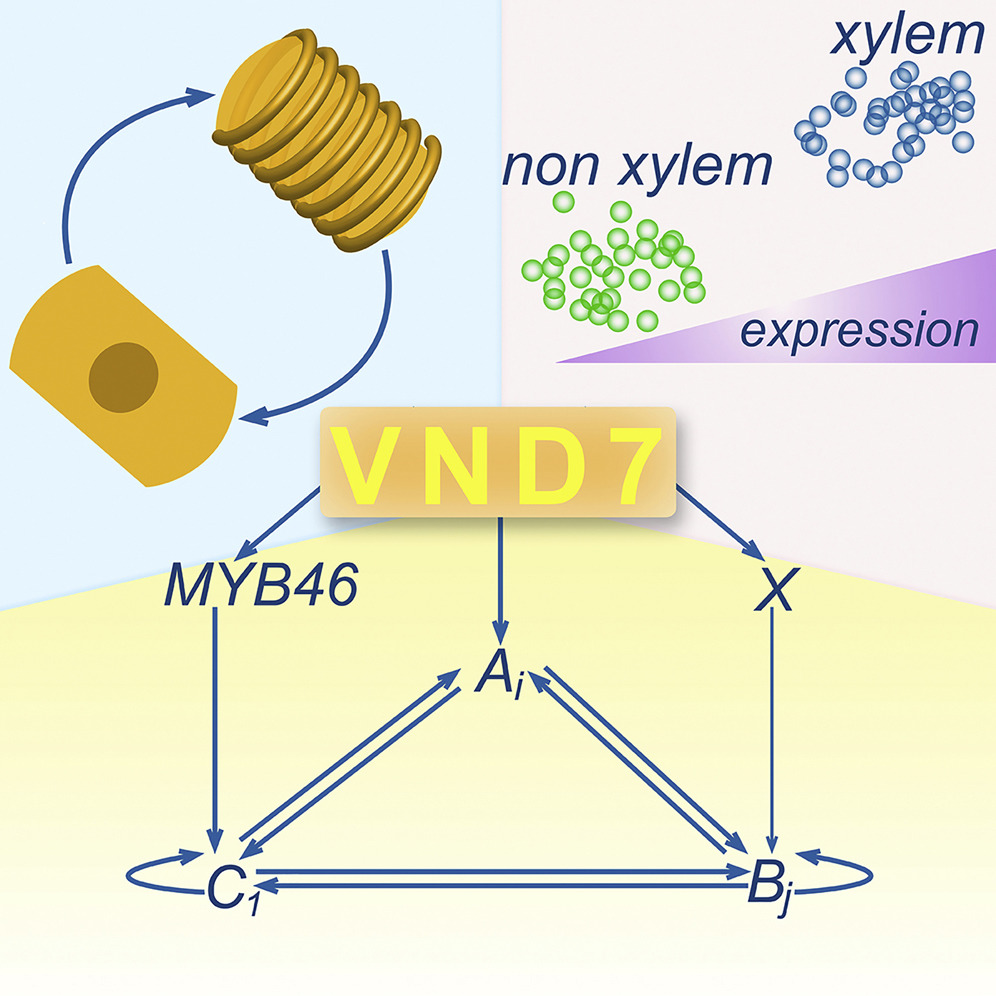
Molecular mechanisms driving switch behavior in xylem cell differentiation (Cell Reports)
Plant Science Research WeeklyXylem is involved in the movement of water and mineral nutrients through the plants from the roots to leaves; its cells are not totipotent and undergo programmed cell death. VASCULAR-RELATED NAC-DOMAIN (VND) transcription factors are master switches of xylem cell differentiation in Arabidopsis and much…