COPing with temperatures: COP1 acts as a molecular thermometer
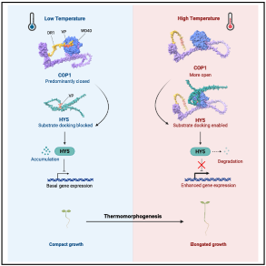 In recent work, Zeng et al. unravel a novel mechanism by which plants perceive changes in temperature. Specifically, they found that COP1, an E3 ligase known as a central integrator of light signaling, also functions as a thermosensor in Arabidopsis. At low temperatures, a Val-Pro (VP) motif of COP1 binds its own WD40 domain, locking COP1 into an inactive conformation. In this state, client proteins, like the growth repressor HY5, are not accessible to COP1. As a result, HY5 accumulates, suppressing plant growth. Conversely, as temperatures rise, the VP motif detaches, enabling a conformational change. In this more open and active state, COP1 binds HY5 and targets it for degradation leading to the activation of genes involved in stem elongation. The VP motif is located at the N-terminus of an intrinsically disordered region (DR1) and altering its length or the aminoacidic sequence changes the plant’s thermal response. Additionally, the authors found that variability in the linker length across the Arabidopsis accessions tune the temperature sensitivity of COP1. Specifically, the DR1 flexibility positively correlates with geographic latitude, providing a mechanism plants used to adapt and grow in colder environments. (Summary by Emma Olmi @olmiemma.bsky.social) Cell 10.1016/j.cell.2026.10.036