
Close, but not random: how plant receptors find their partners.
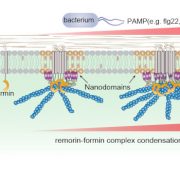
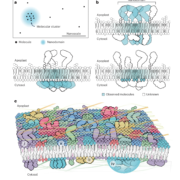
 Nanodomains, also known as lipid rafts, temporarily group proteins within the plasma membrane, to efficiently perform cellular processes such as extracellular sensing. This study examines the unclear association dynamic of a very important plant plasma membrane receptor family, the Leucine-Rich Repeat Receptor Kinases (LRR-RKs), known for their critical functions in development, immunity, and reproduction. Using advanced fluorescence microscopy techniques and a variant of single-particle localization microscopy (spt-PALM), the authors studied a minimal LRR-RKs response network, composed of two ligand binding receptors; FLS2 that binds flagellin (a protein of the bacterial flagella) and the BRI1 receptor, that binds the plant hormone brassinosteroid; their common co-receptor BAK1, and their accessory receptor BIR3, which regulates the association between FLS2, BRI1, and BAK1. Unlike animal protein association dynamics, the two ligand-receptors, FSL2 and BRI1, are pre-organized into well-defined nanodomains; meanwhile, BAK1 has a diffuse distribution. However, the accessory receptor BIR3 maintains an available pool of BAK1 near FSL2 and BRI1, allowing the triggering of cellular response. This study thus provides visual evidence for receptor dynamics during the formation of ligand-induced complexes, which arise from the relative spatial positioning of their components rather than from random protein encounters within plasma nanodomains. (Summary by Montserrat López-Coria). bioRxiv https://doi.org/10.64898/2026.03.05.709869