


Review: Light-harvesting antenna complexes in Physcomitrella patens: implications for evolutionary transition from green algae to land plants ($)
Plant Science Research Weekly, Research0 Comments
/
The ancestors of land plants were aquatic. Myriad changes accompanied the transition from aquatic to terrestrial life, including changes necessitated by the difference in light intensity and quality. Bryophytes, the earliest diverging land plants, have some characteristics that reveal how plants transitioned…

Nature Outlook Supplement: Food Security (OA)
Plant Science Research Weekly, ResearchNature has published an Outlook feature on the topic of Food Security with the following overview articles, all useful for teaching:
Food security, Nutrition: A world of insecurity, Agrobiodiversity: The living library, Bioengineering: Solar upgrade, Egypt: Space to grow, Perspective:…


What We're Reading: April 28
Blog, ResearchCorrespondence: Discussion about the US National Academies GE crop report ($)
A series of letters has been published in Nature Biotechnology on the topic of the US National Academies report Genetically Engineered Crops: Experiences and Prospects. From Dec 2016, US National Academies report misses…

Brassica oilseeds transporter gene mutations decrease antinutritional glucosinolates
Plant Science Research Weekly, ResearchGlucosinolates are sulfur-containing defense compounds produced by brassica plants. Brassica napus (canola) is an important oilseed crop because a low-glucosinolate variety has been developed. Brassica juncea is more stress tolerant, but has not been developed as a crop due to its high levels of glucosinolates.…

Tissue-specific transcriptomics shows the unfolded protein response’s role in maintaining fertility upon heat stress ($)
Plant Science Research Weekly, ResearchPlant reproduction is particularly sensitive to heat stress, so rising temperature is a major threat to food security. Zhang et al. surveyed the transcriptional responses to heat stress (3 h at 37º) in Arabidopsis and identified large differences between vegetative and reproductive tissue responses…

Zeaxanthin-dependent nonphotochemical quenching does not occur in photosystem I in Arabidopsis thaliana
Plant Science Research Weekly, ResearchPhotosynthesis in plants involves two photosystems acting in series, Photosystem I (PSI) and PSII. Each photosystem is a massive complex consisting of numerous proteins and pigments. The photosystems are efficient at light harvesting but also sensitive to high-light induced photooxidative damage. Photosynthetic…
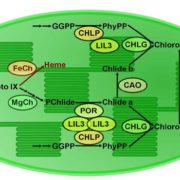
LIL3, a light-harvesting complex protein, links terpenoid and tetrapyrrole biosynthesis
Plant Science Research Weekly, ResearchThe final step in the synthesis of chlorophyll is the joining of chlorophyllide, (a tetrapyrrole with planar structure similar to heme) to a linear lipid (a product of the terpenoid pathway) that provides an attachment point for the resulting chlorophyll to pigment-binding proteins of the light-harvesting…

PIF4-controlled auxin pathway contributes to hybrid vigor in Arabidopsis thaliana
Plant Science Research Weekly, ResearchHybrid vigor is a well-known but still poorly understood phenomenon in which the F1 hybrid progeny of a cross often show enhanced growth as compared to either parent. True-breeding lines that retain this enhanced growth, known as hybrid mimics, have been developed and are important tools for understanding…