

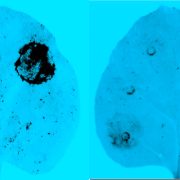
ADP-ribosylation and plant immunity
The Plant Cell: In a NutshellYoon, Middleditch, and Rikkerink explore how a Pseudomonas syringae ADP-ribosyl transferase effector modifies RPM1-INTERACTING PROTEIN4 to activate the host R protein RPM1 in disease resistance.
Minsoo Yoon, The New Zealand Institute for Plant and Food Research Limited, Auckland, New Zealand
Background:…

Review: Photorespiration is the solution, not the problem
Plant Science Research WeeklyRubisco (ribulose 1,5-bisphosphate carboxylase/oxygenase) is one of a kind, simultaneously recognized as one of the most abundant and important enzymes, and also widely characterized as flawed because it uses both O2 and CO2 as substrates, leading to both carboxylation and oxygenation of ribulose bisphosphate.…
Review: One plant’s poison
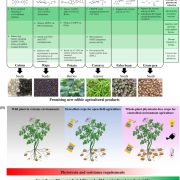
Plant Science Research WeeklyPlants synthesize interesting chemicals that attract, deter, amuse, and harm their predators. Some of the most harmful to humans have been selectively eliminated through the process of domestication, but others render potential food sources inedible. This review by Liu et al. discusses four approaches…
Review: How floral meristem termination shapes flowers
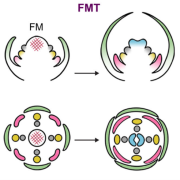
Plant Science Research WeeklyFlowers come in a breathtaking variety of shapes and sizes. The structures making up a flower, called sepals, petals, stamens, and carpels, all derive from the tightly regulated differentiation of a pool of stem cells in the so-called floral meristem. Floral meristem termination (FMT) is a crucial stage…
Roots of misinformation on common mycorrhizal networks in forests
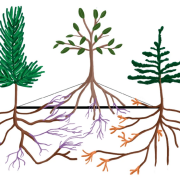
Plant Science Research WeeklyAs an educator, I reply on metaphors and stories to engage my readers, yet the line between hyperbole and engagement is thin. The concept of plant-plant communication is exciting, and certainly has some truth, but unfortunately has spilled over into a narrative that perhaps is more fiction than fact.…
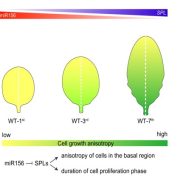
Anisotropic cell growth at the leaf base promotes age-related changes in leaf shape
Plant Science Research WeeklyThe Arabidopsis thaliana leaf exhibits dramatic phenotypic changes across the juvenile-to-adult phase transition during vegetative development. For example, juvenile leaves are small, round, and lack trichomes (leaf hairs). By contrast, adult leaves contain trichomes on the abaxial (or lower) leaf surface,…

PIF4 regulates microtubule organization to mediate high temperature–induced hypocotyl elongation
Plant Science Research WeeklyPlant growth adaptation to heat stress (thermomorphogenesis) is regulated by changes in plant morphology such as petiole and hypocotyl elongation. One of the known players in this response is PHYTOCHROME-INTERACTING FACTOR 4 (PIF4), a central regulator of hypocotyl elongation. However, the mechanisms…

Mechanism behind ripened green bananas under high temperature
Plant Science Research WeeklyHeat stress is a common consequence of global warming for terrestrial plants, and it can have devastating effects on growth and yield. In terms of fruit ripening, high temperature is one of the most significant abiotic stresses inhibiting quality formation. During fruit ripening, chlorophyll breaks down…
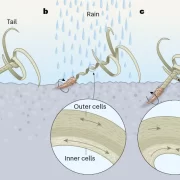
Inspired by nature: Self-burying seeds
Plant Science Research WeeklySelf-burying seeds are high on the list of “aren’t plants amazing”. Seeds of several species carry appendages that change shape when exposed to moisture and that are oriented in such a way so that their shape changes push the seed underground (don’t take our word for it – see https://youtu.be/TOJG5mF6OLs).…