

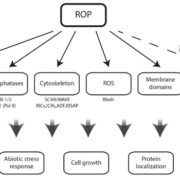
Update: ROP GTPases structure-function and signaling pathways
Blog, Plant Physiology, Plant Physiology: Updates, Research, Research BlogBy Gil Feiguelman, Ying Fu, and Shaul Yalovsky
Introduction
Rho of Plants (ROP) proteins also known as RACs are the plant specific subfamily of Rho small GTP binding proteins, referred to here as small G proteins (Zheng and Yang, 2000; Brembu et al., 2006; Elias and Klimes, 2012). Like other members…
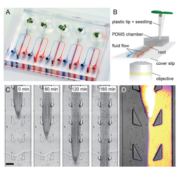
Arabidopsis perfusion platform RootChip reveals local adaptations of roots
Blog, Plant Science Research Weekly, Research, Research BlogRoots are essential plant organs that need to respond and adapt to dynamic environments. It is still unknown if these adaptations are based on systemic or cell-based responses. Stanley and colleagues created the dual-flow-RootChip, a platform for the heterogeneous perfusion of Arabidopsis roots to…
J. Exp. Bot. Special Issue. The plant cuticle: old challenges, new perspectives ($)
Blog, Plant Science Research Weekly, Research, Research BlogThe cuticle is a cell-wall polymer that protects against desiccation, pathogens and UV light. Domínguez et al. provide an open-access editorial that describes this fine collection of articles covering all aspects of the plant cuticle, from its evolutionary origins to its ecological significance. Within…
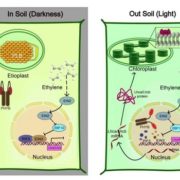
EIN3 and PIF3 interdependently repress chloroplast development in buried seedlings
Blog, Plant Science Research Weekly, Research, Research BlogDuring embryogenesis, plastids arrest their differentiation as etioplasts (characterized by the distinctive prolamellar bodies, PLBs), and remain poised to complete their differentiation into functioning chloroplasts upon exposure to light. Liu et al. explored the factors that interact to effect this…
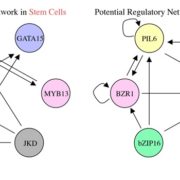
Chromatin accessibility changes between Arabidopsis stem cells and mesophyll cells illuminate cell type-specific
Blog, Plant Science Research Weekly, Research, Research BlogWhat gives stem cells their plasticity and why are differentiated cells so specialized? Sijacic et al. approach this question by analyzing transcription factor (TF) accessibility to chromatin. Nuclei were isolated from shoot apical meristem (SAM) pluripotent stem cells and fully-differentiated mesophyll…
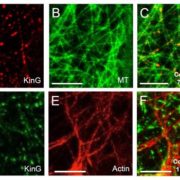
A plant-specific kinesin KinG regulates intra- and intercellular movement of SHORT-ROOT
Blog, Plant Science Research Weekly, Research, Research BlogSHORT-ROOT (SRT) is a transcription factor that has previously been shown to move between cells and so contribute to developmental patterning. Spiegelman et al. investigated the cellular machinery that contributes to SRT’s movement. Previous work showed that the movement of SRT depends on the endosome…
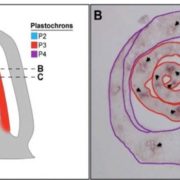
SHORTROOT-mediated increase in stomatal density has no impact on photosynthetic efficiency
Blog, Plant Science Research Weekly, Research, Research BlogSHORTROOT (SRT) is a transcription factor that contributes to developmental patterning non-cell autonomously, by moving between cells. In leaves, SRT has been shown to contribute to sub-epidermal patterning specified by distance from the vein. Schuler et al. explored whether it also contributes to epidermal…
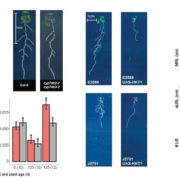
Genetic components of root architecture remodeling in response to salt stress
Blog, Plant Science Research Weekly, Research, Research Blog
While everyone knows that salt stress reduces root growth, Julkowska and colleagues examined salt-stress induced changes in Root System Architecture (RSA) by studying 347 Arabidopsis accessions. The authors collected 17 RSA traits and developed an app allowing interactive exploration of collected…
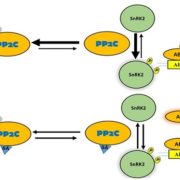
Members of the abscisic acid co-receptor PP2C protein family mediate salicylic acid-abscisic acid crosstalk
Blog, Plant Science Research Weekly, Research, Research BlogIf we know anything about how ABA regulates plant response to environmental stresses it is that the pathway if very complicated and anything but straightforward. The ‘core’ ABA pathway is activated by first inhibiting a specific class of protein phosphatases, PP2Cs. This inhibition of PP2Cs allows…