
Not all arbuscules pull the same weight
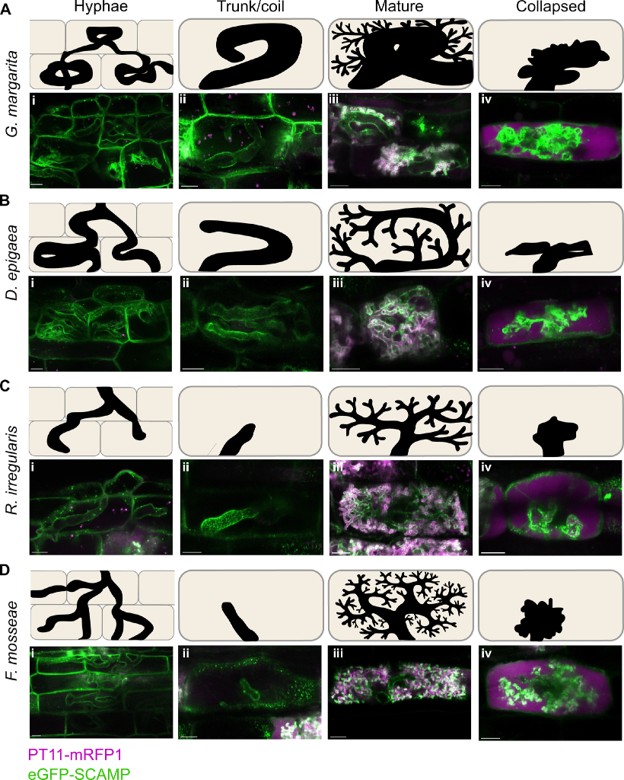 Arbuscular mycorrhizal (AM) fungi trade soil phosphate for plant carbon at arbuscules, the short-lived, branched hyphal structures they build inside root cortical cells, but how phosphate uptake is coordinated across this constantly changing interface has been hard to observe. McGaley et al. used non-invasive, time-lapse confocal imaging of live rice roots to follow individual arbuscules from formation to collapse, revealing wide variation in both developmental trajectory and lifespan. Tracking the AM-specific phosphate transporter PT11 with functional fluorescent reporters, they found its localization strikingly consistent: across four taxonomically diverse fungal partners, PT11 always accumulated on the membrane around the finest arbuscule branches and disappeared as the structure collapsed. Yet the amount of PT11 varied substantially from one arbuscule to the next, even between neighboring cells, and this abundance rose under low-phosphate and fell under high-phosphate fertilization. Promoter swap experiments teased the two apart: one construct broadened PT11’s location but kept its phosphate responsiveness, another broadened location and abolished responsiveness. Only the constructs that preserved nutrient responsive tuning, not those preserving precise location, restored PT11 function in the mutant. The work argues that arbuscules are not interchangeable units of exchange, with implications for how root colonization is interpreted. (Summary by Trevor Melusen) Nature Comms 10.1038/s41467-026-71496-8