


What We're Reading: February 24
Plant Science Research Weekly0 Comments
/
Insight: Why we need more non-seed plant models
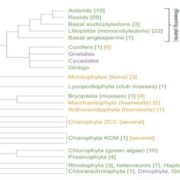
There is much to be learned from comparing plant genomes, but as Rensing writes, currently available genomic data are skewed heavily towards angiosperms. He argues that a richer understanding of plant evolution depends upon gaining insights into…
Insight: Why we need more non-seed plant models
Plant Science Research Weekly, ResearchThere is much to be learned from comparing plant genomes, but as Rensing writes, currently available genomic data are skewed heavily towards angiosperms. He argues that a richer understanding of plant evolution depends upon gaining insights into the non-seed plants, including ferns, mosses and liverworts,…
Immunity at hydathodes controls bacterial infection ($)
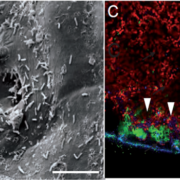
Plant Science Research Weekly, ResearchHydathodes are the sites of guttation, which is a process by which water and solutes are pushed out of leaves by the force of root pressure when the rate of transpiration is low (for example at night). Hydathodes have numerous stomata-like pores and are located near vascular ends. Like stomata, hydathodes…
Dissecting transposon silencing through introduction of exogenous TEs
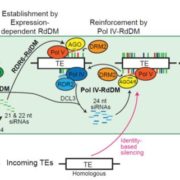
Plant Science Research Weekly, ResearchFultz and Slotkin explore the question of how transposable element (TE) silencing is initiated. As they describe, there are two recognized mechanisms, one based on TE identity (meaning that it can be silenced through siRNAs initiated from a related TE, and in which de novo silencing can occur in the…
Changes in anthocyanin production during domestication of Citrus
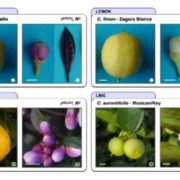
Plant Science Research Weekly, ResearchFamiliar citrus fruits such as sweet orange, lemon, lime and grapefruit are hybrids of three species: Citrus reticulate (mandarin), C. medica (citron), and C. maxima (pummelo). Cultivated varieties are generally vegetatively propagated, with diversity arising from spontaneous or induced somatic mutations.…
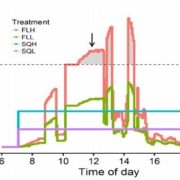
Importance of fluctuations in light on plant photosynthetic acclimation
Plant Science Research Weekly, ResearchPlant growth chambers are indispensable for most plant science researchers, but of course they do not replicate the outdoor environment. Vialet-Chabrand and Matthews et al. explore the effect of realistic, dynamic fluctuating light (for example as influenced by clouds and leaves) versus light provided…
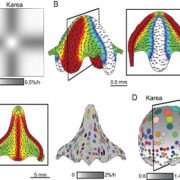
Generation of shape complexity through tissue conflict resolution
Plant Science Research Weekly, ResearchIt’s easy to visualize how a sheet of cells grows, but how does a sheet of cells form a complex, three-dimensional structure? Rebocho et al. describe how differential growth rates between cell layers and across the growing surface can produce a variety of complex shapes. As a model for shape complexity,…
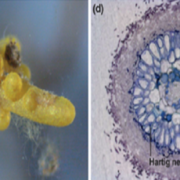
Review: Mycorrhizal ecology and evolution: the past, present and the future
Plant Science Research Weekly, ResearchThere are about 50,000 fungal species that form mycorrhizal associations with about 250,000 plant species. These associations significantly increase plant productivity by increasing nutrient uptake, particularly nitrogen and phosphorus, although with a considerable carbon cost to plants. Van der Heijden…
Review: Isoprene research – 60 years later, the biology is still enigmatic ($)
Plant Science Research Weekly, ResearchSixty years ago, the first report of isoprene (C5H8; 2-methyl-1,3-butadiene) emissions from plants was published. Isoprenes are the largest source of non-methane hydrocarbons in Earth’s atmosphere; furthermore, isoprene is reactive in atmospheric chemistry and can be converted into a variety of harmful…