

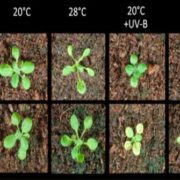
UV-B perceived by the UVR8 photoreceptor inhibits plant thermomorphogenesis
Plant Science Research Weekly, Research0 Comments
/
Ambient temperature can influence plant architecture, an effect termed thermomorphogenesis. In A. thaliana, thermomorphogenesis phenotypes include stem elongation and changes in leaf elevation angles. Increased auxin biosynthesis involving the transcription factor PIF4 is required for thermomorphogenesis,…

Homeodomain protein underpins leaf shape variation in cotton ($)
Plant Science Research Weekly, ResearchHomeodomain transcription factors are well-known as regulators of developmental patterning, including in leaves. Andres et al. examine the molecular basis behind leaf shape in cotton, particularly the Okra locus that was identified by breeders as a regulator of leaf shape. They show that the Okra locus…

Review: The many roles of AVP1, a H+-PPase ($)
Plant Science Research Weekly, ResearchThe AVP1 gene encodes a proton-pumping pyrophosphatase (H+-PPase) localized to the vacuolar membrane, which means that it pumps H+ into the vacuole using energy stored in pyrophosphatase (PPi). The direct consequences of its action are the acidification of the vacuole and the removal of PPi from the…
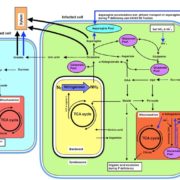
Review: Adaptive strategies for N metabolism in P deficient legume nodules ($)
Plant Science Research Weekly, ResearchLegume nodules fix N, but their function has a high requirement for P, making nitrogen-fixation highly sensitive to P deficiency. Valentine et al. review how P limitation affects nodule function and also how nodules respond and adapt to P deficiency, drawing largely on studies of Virgilia divaricata,…

Review: Transport and homeostasis of K & P ($)
Plant Science Research Weekly, ResearchNitrogen (N), phosphorus (P), and potassium (K) are the three macronutrients required in highest amounts for plant growth. N is abundant in the atmosphere, therefore plentiful if we overlook the energetic costs of converting N2 to usable form. By contrast, K and P are present in limited amounts in the…

Recognizing featured Plant Cell first authors, December 2016
Research, The Plant Cell, The Plant Cell: Author ProfilesRecently, we’ve been profiling first authors of Plant Cell papers that are selected for In Brief summaries. Here are the first-author profiles from the December issue of The Plant Cell.
Yao-Pin Lin, featured author of Identification of Chlorophyll Dephytylase Involved in Chlorophyll Turnover in Arabidopsis
Current…
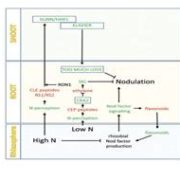
Review: Nitrogen sensing in legumes ($)
Plant Science Research Weekly, ResearchAs a consequence of their ability to fix nitrogen in symbiosis with bacteria, legumes make key contributions to ecosystems and provide protein-rich foods for humans and other animals. Recent years have uncovered the nature of the signals involved in the cross-kingdom dialogues that occur between plant…
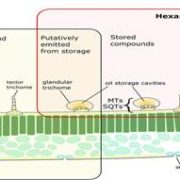
Aphid colonization on tansy influenced by emitted terpenes
Plant Science Research Weekly, ResearchTansy plants (Tanacetum vulgare L.) have diverse ethnobotanical uses including that of insect repellent, as a consequence of their production of volatile terpenes. Clancy et al. investigated the diversity of these emitted terpenes, and how they affect colonization by aphids and the ants that tend them…
Domestication impacts on plant–herbivore interactions: a meta-analysis
Plant Science Research Weekly, ResearchIt is widely stated that domestication has contributed to a decrease in plant resistance to herbivory, but to what extent is this true? In a contribution to a special issue on “Human influences on evolution”, Whitehead et al. describe results of their meta-analysis. Although their data show a consistent…